Nearly 100 years ago on Christmas Day, something special happened in Lake Placid, an event that still echoes through these mountains and around the world.
On wooden sleds with metal blades, daredevils zoomed down North America’s first-ever bobsled track, built at Mt Van Hoevenberg for the 1932 Winter Olympic Games. That moment marked the beginning of Lake Placid’s ascent as an international powerhouse in sliding sports.
Today, thanks to the solid support from the State of New York, we are once again preparing to welcome the world’s best luge athletes for not one but two World Cup events to be held at a newly and fully modernized venue that we are proud to say provides among the best visitor and athlete experiences on the planet.
The Early Beginnings
In April of 1930, after winning the bid to host the Olympic Winter Games in Lake Placid, Polish engineer and famed track designer, Stanislaus Zentzytzki, was hired to design North America’s first bobsled track along the contours of the north slope of Mt Van Hoevenberg.
At the time, bobsled was the only sliding sport in the Olympics, so skeleton and luge were not considered in the design and were not part of the planning. The four-man bobsled was the Olympic standard at the time, and the 2-man bobsled event debuted at the 1932 Games.
The heavy work began in August of that year with Earth and rock being dug and blasted and moved into place using horses and wagons and manpower. The entire 1.5-mile length of track was fashioned largely with soil on the straight-aways with local heavy stone laid between wooden ribbing on the curves. Blocks of ice harvested from Mirror Lake were laid in the curves to create the best possible surface for a track that, in those early years, had no refrigeration system.
Parts of this historic, second-oldest track in the world can still be seen high on the mountain on a hiking trail above the current start house.
Following European tradition, each curve was given a name. Soon, Whiteface, Shady, Little S, and Zig Zag became respected features, well-known among the athletes and coaches around the world. The entire length of track was used for the 1932 Winter Games, including the feared Whiteface hairpin curve, which drew special attention for its difficulty. U.S. athletes won gold and silver in both the two-man and four-man events. Eventually, the danger of the Whiteface curve led organizers to shorten the track in advance of the 1939 Bobsled World Championships.
Over the following decades, the track served as a national center for training and competition as the sport, the athletes, and the sleds evolved. The U.S. national teams were selected from regional bobsled clubs as well as from development teams representing the U.S. Air Force, Marines, and Navy.
A New Age Ushers in Technical Evolution
In advance of the 1980 Winter Games in Lake Placid, the entire track was rebuilt using concrete construction and equipped with a complete refrigeration system. Simultaneously, a separate refrigerated track was built for luge, the first and only time in Olympic history that a dedicated track was required. All bobsled, skeleton, and luge events in subsequent Games around the world have since been held on combined tracks.
Following the 1980 Games, the Olympic Regional Development Authority (Olympic Authority) was created by the New York State Legislature to manage the Olympic venues and protect the public’s investment. With the leadership of the Olympic Authority, Mt Van Hoevenberg continued to be a premier location for training and competitions, including National Championships, World Cup events, the Olympic Trials, and even World Championships.
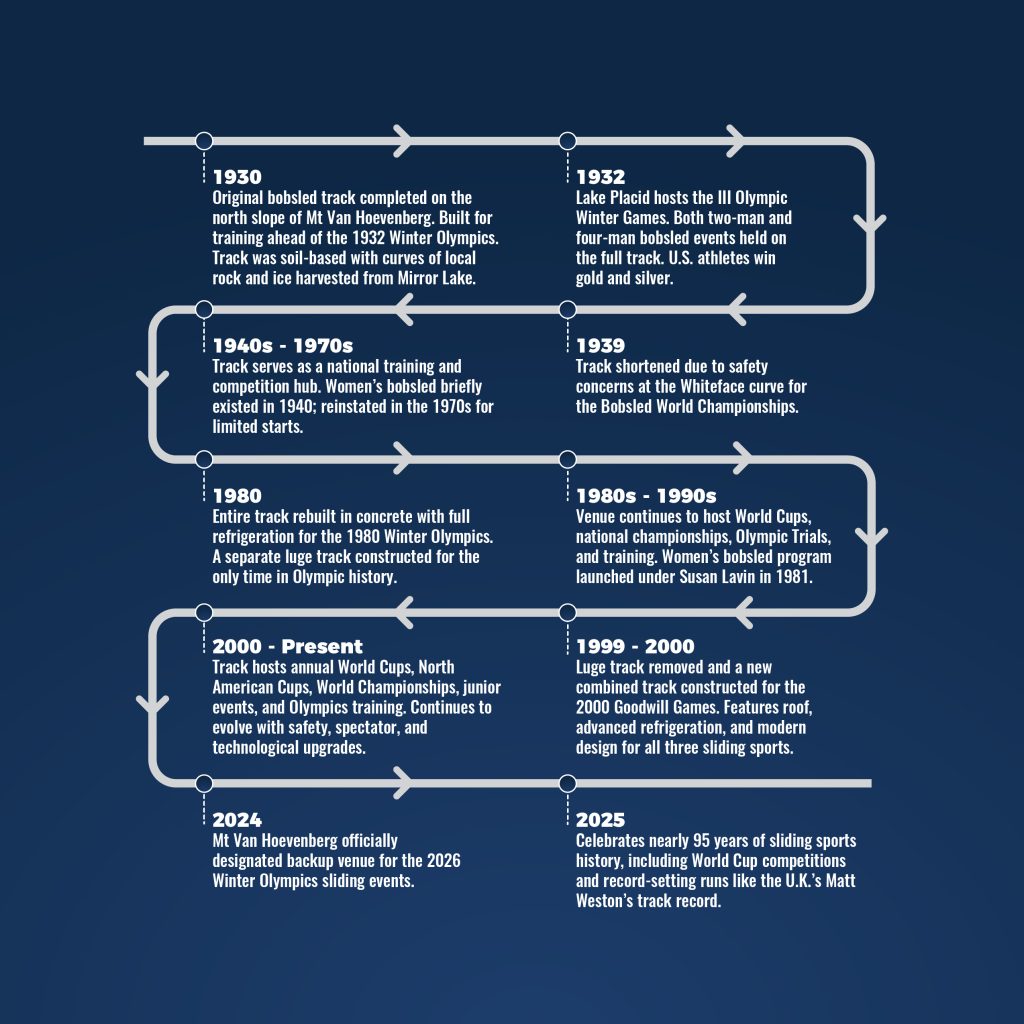
After years of heavy use, that 1980 track was in need of replacement to bring it into compliance once more with changing international standards for all three sliding sports. In 1999, the luge track was removed, and a new combined track was constructed in advance of the 2000 Goodwill Games. With a complete roof, new canopy shading, and an advanced refrigeration system, the redesigned venue offered improved consistency, safety, and fairness for athletes.
The new 1,680-meter (one mile) track features 20 curves – the most of any sliding track in the world. With the high speeds produced by the track’s gradient – nine percent average and 20 percent maximum with a total vertical drop of 128 meters – these curves demand expert technical steering. As a result, Mt Van Hoevenberg has long been considered one of the most technically demanding tracks for sliders of all disciplines. One section, in fact, includes five curves in quick succession while also dropping quickly in elevation. Dubbed the “Devil’s Highway,” this section is widely known to make or break a run.
Birthplace of Women’s Sliding Sports
Having hosted so many major sliding competitions, the Mt Van Hoevenberg track is already historically significant, but this one fact boosts that exponentially – it is where women’s sliding sports began. For a short period in 1940, international bobsledding competition was open to women, but following Katherine Dewey driving a co-ed sled to victory in the national championships that year, women were banned from the sport.
Then, in the 1970s, women began sliding again, initially from the half-mile start point. The first woman licensed driver since Katherine Dewey was the Plattsburgh Bobsled Club’s Lynn VanArman. Others followed not long after with Lois Hollan, Lisa Yanchitis, and Betsy Napier, who helped establish unsanctioned races.
Then came Susan Lavin, who during the 1980 Olympic Winter Games was Mt Van Hoevenberg’s venue manager. While working for the New York State Department of Environmental Conservation, she transitioned in 1981 to the newly formed Olympic Authority and launched the world’s first formal women’s bobsled program. Though Susan never drove a bobsled, she rode in many during her tenure, championed women’s bobsled in Lake Placid, and helped shape sliding sports for women all over the world. Finally, in 1983, Mt Van Hoevenberg hosted the World Bobsled Championships, which included the first sanctioned all-women’s bobsled race since 1940.
Extensive Competitive Footprint
Mt Van Hoevenberg is a regular, nearly annual host of World Cup sliding events and has remained a central site for major competitions throughout the nearly 100 years since sliding sports took root in North America. The venue is also the historic host of 13 Bobsled and Skeleton World Championships, two International Luge Federation (FIL) World Championships, two FISU World University Games, Junior World Championships, North American and Pan American Championships and, of course, two Winter Olympic Games.
Additionally, the venue continues to host numerous North American Cups and other national and international events, such as the 2023 World Push Championships that took place on the indoor push track. It was also the first track in the world to host a World Championship for all three sliding sports (bobsled, luge, and skeleton) in the same non-Olympic year (2009).
With such a historically important track in the world of sliding sports, Mt Van Hoevenberg is naturally home to many iconic moments in competition, including most recently, the U.K.’s Matt Weston setting a track record for skeleton and winning the 2025 World Championship. A treasure trove of photos and video footage from training and competitions throughout the decades, much of it now available on various sites online, provides poignant images from across the span of the sport’s history.
The competitive footprint of this historic venue continues to expand. Just recently in December of 2024, Mt Van Hoevenberg was officially designated as the backup venue for the 2026 Winter Olympics sliding competition should the construction of the new Eugenio Monti Olympic Track in Italy not be completed in time.
Serving Athletes Throughout the Year
Though they compete in winter sports, sliding athletes at all levels train year-round at Mt Van Hoevenberg. With a weight training facility, an indoor sprint track, and the only indoor refrigerated bobsled and skeleton push track in the U.S., the venue is a hub for youth athletes, the U.S. national team, U.S. development training, and teams from around the world, especially those nations that lack their own sliding tracks. The Jamaican team, for example, has trained consistently at Mt. Van Hoevenberg since its earliest years in international competition.
New Mountain Pass Lodge & All New Visitor Experience
There truly is nowhere else like Mt Van Hoevenberg. In addition to the sports and competitions, the venue’s distinctively diverse array of adventure, activities, and amenities are a major attraction for everyone. Founded, developed, and maintained as an athlete training and competition venue, it also serves throngs of recreational enthusiasts and visitors of all kinds and all abilities across all seasons, and the massive new Mountain Pass Lodge is the hub for all of it.
The lodge’s three stories and 55,000 square feet provide visitors with a convenient central campus that welcomes the world for a wide array of adventures and activities. Ample parking surrounds the fully accessible lodge, which houses Mountain Pass Mercantile and Swix Store (retail gear and gifts), the 81-18 Café (offering options from vegan to classic fare), a rental shop for ski and bike gear, Hi Notch Indoor Climbing for all ages, and Henry’s Tavern, a comfortable spot for watching athletes on the Indoor Push Track. The lodge sits square in the middle, placing all of these amenities directly adjacent to the 55km of ski, run, hike, and bike trails, a new biathlon stadium, roller ski trails, the combined sliding sport track, and the trailhead of the Mt Van Hoevenberg East Trail that gives way to extraordinary views of the High Peaks at the mountain’s summit.
Plus, with the new lodge comes four seasons worth of unique and exciting activities for visitors, too. In addition to cross-country skiing with the world’s most powerful snowmaking system dedicated to a Nordic ski facility, there’s mountain biking, hiking, snowshoeing, a Skeleton Experience and Bobsled Experience on the Olympic sliding track, Discover Luge and Discover Biathlon.
Right outside the lodge is also the Cliffside Coaster – North America’s longest mountain coaster – an exhilarating thrill ride for anyone. Over the coaster’s entire path down the mountain following the 1980 sliding track, the speed of the bobsled-like coaster car is placed in the riders’ control. The Coaster also comes complete with audio narration highlighting the venue’s Olympic history.
Additionally, Mt Van Hoevenberg staff offers a guided Legacy Tour that introduces visitors to the venue’s Olympic past and its long lineage of sports, events, and recreation.
Even more recent improvements create an increasingly better spectator experience on the sliding track. Terraced walkways now provide not only greatly improved access to sliding sport events but also serve to enhance viewing opportunities with a multi-level plaza and new concession and restroom infrastructure. In combination, these latest upgrades make for better, easier, 360-degree viewing of training and competition on the sweeping turns of the track’s lower section known as “the heart.”
In designing the Mountain Pass Lodge, the Olympic Authority team considered all possible uses and created large comfortable spaces that can each serve multiple purposes. The upstairs lounge with floor to ceiling windows and a spacious deck looking out on the stadium is a great example. There, one can relax in plush furniture and an environment decorated in a combination of Adirondack and European ski lodge design. The space also accommodates large group functions, presentations, and other gatherings. Similarly, Henry’s Tavern upstairs serves as not only a great place to watch all the Push Track activities but also can easily turn into a VIP lounge or party room for a special celebration.
Together, these features offer a one-of-a-kind center for families, athletes, and spectators alike to fully enjoy all that Mt Van Hoevenberg offers.
Staffing, Governance, and Volunteers
Operated and managed by the Olympic Authority, its leadership drives the ongoing development of this world-class and world-famous venue. Programming, capital improvements, and other advancements — such as the new snow storage program that preserves large volumes of snow over summer to jumpstart the winter season — are guided by experienced leaders passionate about sport, recreation, and history.
But a steep track of ice a mile long, 55 kms of expertly groomed ski trails, and top-notch guest services also require a dedicated, skilled team that understands the venue’s sports and visitor experience needs. Expert technicians carefully maintain the track’s surface with the help of ice plant and refrigeration staff. Data and timing professionals ensure the integrity of training and competitive results. A specialized medical team and course marshals ensure everyone’s health and safety across all sports and activities. Guest services, food services, and other staff in the lodge are ready all along the way to create the best possible experience for everyone at Mt Van Hoevenberg. Additionally, the many competitions in many sports across the seasons also rely on the dedication and eager participation of hardworking event volunteers.
From the venue manager to the track chief to the local sliding clubs and the national and international governing bodies (International Bobsled and Skeleton Federation and the International Luge Federation) and the entire Mt Van Hoevenberg Team, everyone works together.
Sustainability and Mt Van Hoevenberg’s Future
In alignment with the continual improvements at Mt Van Hoevenberg is the Olympic Authority’s commitment to environmental sustainability, a pillar that supports all our work and helps preserve our world’s winters and ensures the venue remains a world-class facility for future generations. From improved refrigeration and lighting efficiencies to the track’s roofing and shading to maintain its consistency during competitions to sustainable trail maintenance practices and much more, environmentally sustainable operations are central to the long-term stewardship of this iconic site.
Today and always, New York State’s “Excelsior” motto – the Latin term for “Ever Upward” – reflects Mt Van Hoevenberg’s journey from North America’s first bobsled track to a world-class, four-season center for sport and recreation. The continual striving toward excellence that’s been this venue’s hallmark over decades continues steadfastly to ensure it remains a beacon of athletic achievement and recreation, serving athletes, visitors, the Olympic Region, and the State of New York for generations to come.